

I used to be a checked-bag person. Not by choice, exactly, but by conviction. I believed, with the fervor of a religious convert, that there was no way a human being could survive a two-week trip with anything smaller than a medium-sized suitcase. I would stand at my bedroom door, staring at a mountain of clothing, shoes, and “just in case” items, and I would think, “What if it gets cold?” What if it gets hot? What if I get invited to a fancy dinner? What if I spill coffee on my only nice shirt? What if I need my hair straightener, my curling iron, and my travel blow dryer? What if, what if, what if.
And so I would pack it all. The jeans I hadn’t worn in six months suddenly felt essential. The book I had been meaning to read for three years. The extra pair of sneakers “for walking.” The jacket that weighed as much as a toddler. I would wrestle that suitcase shut, sit on it, zip it with a triumphant grunt, and wheel it to the airport feeling like a prepared, responsible adult.
Then I would arrive at my destination, unpack in a hotel room the size of a walk-in closet, and realize I had packed for a theoretical version of my trip that did not exist. I would wear the same four things on repeat. I would lug that heavy suitcase up subway stairs, over cobblestones, and through train stations, sweating and swearing and wondering why my shoulders hurt. And on the way home, I would stare at the pile of unworn clothes and think, “I carried you across an ocean for nothing.”
The turning point came in Lisbon. I was traveling alone, which meant no one was there to help me with my bag when the elevator in my Airbnb broke. I dragged that thing up four flights of stairs in 90-degree heat, and by the time I reached the top, I was so angry at my past self that I made a decision. On the flight home, I would only bring a carry-on. And not just for weekend trips. For everything. Two weeks in Italy? Carry-on. Ten days in Japan? Carry-on. Fourteen days in Peru? You guessed it. Carry-on only.
It took a few trips to get it right. I underpacked once and had to buy a sweater in Copenhagen that cost roughly the same as a small car. I overpacked another time and had to gate-check my bag because I got cocky with the souvenirs. But eventually, I figured out the formula. And now, after years of traveling with nothing but a 40-liter backpack or a small rolling suitcase, I can tell you with absolute confidence: two weeks in a carry-on is not only possible. It is better. It is freer. It is, in many ways, the only way to travel once you know how.
Here is everything I have learned, usually the hard way.
The Mindset Shift: You Are Not Packing for Survival. You Are Packing for a Lifestyle.
The first thing you have to understand is that packing light is not really about luggage. It is about decision fatigue. Every item you bring is a decision you have to make every morning. Which shirt? Which shoes? Which jacket? When you bring thirty outfits, you spend twenty minutes every day staring into your suitcase like it is a magic eight-ball, trying to divine the correct choice. When you bring ten, you grab something and you go. You have more time. You have more mental space. You stop thinking about what you are wearing and start thinking about where you are.
The other mental shift is this: you are not going to the moon. You are going to a place where other humans live, and those humans have stores. If you forget something, you can buy it. If you need something, it exists. The world is not a desert island. It is full of pharmacies and clothing shops and corner stores. The fear that drives overpacking is the fear of being unprepared, but the truth is that you are almost never more than a few blocks away from whatever you need. Trust the world to provide. It usually does.
The Clothing Formula: 5-4-3-2-1
This is the skeleton of every trip I take, and it works in almost every climate with minor adjustments. Five tops. Four bottoms. Three pairs of shoes. Two layers. One dressy outfit. That is it. That is the whole wardrobe.
Five tops sounds scary if you are used to packing a shirt for every day, but here is the secret: nobody cares what you wear. Nobody. The person checking you into the hotel does not care. The person sitting next to you on the train does not care. The person serving you coffee does not care. You could wear the same black t-shirt four days in a row, and the only person who would notice is you. And even you will stop noticing after day two because you will be too busy looking at a cathedral or eating pasta or getting lost in a market.
The key is choosing tops that all go with all the bottoms. Pick a color palette and stick to it like it is a binding legal contract. Mine is navy, black, white, and gray, with one “fun” item, usually a striped shirt because I am basic and I do not care. Every top must match every bottom. This gives you twenty combinations from nine items, which is more than enough for two weeks. If you are feeling wild, add a scarf or a necklace. Accessories take up no space and make the same outfit feel different.
For bottoms, I bring two pairs of pants, one pair of shorts or a skirt, and one pair of comfortable leggings or joggers for sleeping, lounging, or long travel days. Denim is heavy and takes forever to dry, so I limit it to one pair, usually the one I wear on the plane. The other pants are something lightweight and quick-dry, like travel trousers or a pair of dark chinos that can pass for slightly nice.
Shoes are the hardest part. Everyone wants to bring options. Resist. Three pairs is the absolute maximum, and two is better. One pair of comfortable walking shoes. One pair of sandals or flats. One pair of dressier shoes if your trip requires it, though honestly, a clean pair of white sneakers works in almost every restaurant in the world now. Wear the bulkiest pair on the plane. Stuff the smaller ones with socks and underwear to save space. And please, for the love of all that is holy, break in your shoes before you leave. Nothing ruins a trip faster than blisters in a city where you planned to walk ten miles a day.
Layers are where smart packing really pays off. Instead of one heavy coat, bring two lighter layers that work together. A thin fleece or sweater and a packable rain jacket or windbreaker. Worn together, they keep you warm in surprisingly cold weather. Worn separately, they handle everything else. I also bring one nice outfit, which for me is a black dress that weighs nothing and a lightweight cardigan. It works for dinners, for churches that require covered shoulders, and for the random nice event you did not plan for. It takes up almost no room and saves you from feeling underdressed.
Toiletries: The 3-1-1 Gauntlet
If you are flying with only a carry-on, you are living by the TSA’s 3-1-1 rule: all liquids must be in containers of 3.4 ounces or less, inside one quart-sized bag, one bag per passenger. This sounds restrictive, and it is. But it is also a gift. It forces you to bring only what you actually use.
Here is what goes in my liquids bag: toothpaste, face moisturizer with SPF, a small bottle of shampoo, a small bottle of conditioner, and a tiny container of whatever serum I am pretending will fix my face. That is it. Five items. Deodorant, sunscreen, and soap are all available in solid forms now, which means they do not count toward your liquid limit. A bar of shampoo lasts longer than a bottle, weighs less, and will not explode in your bag at altitude. Solid sunscreen sticks exist. Solid perfume exists. Solid cologne exists. The future is solid, and it is beautiful.
Everything else gets decanted into small reusable bottles, the kind you can buy in packs of ten for a few dollars. Do not bring full-sized anything. Do not bring your expensive glass bottle of night cream. Transfer a week’s worth into a plastic pot and leave the heavy stuff at home. If you run out, you can buy more. If you cannot find your exact brand, you will survive. Your skin will not revolt. The local drugstore probably has something interesting you have never tried before.
I also pack a small bag of non-liquid essentials: a razor, a nail file, tweezers, a few hair ties, a small brush, and a travel toothbrush. These go in a separate pouch outside the liquids bag so I am not digging through my one quart of freedom every time I want to brush my teeth.
The Actual Packing: Roll, Don’t Fold
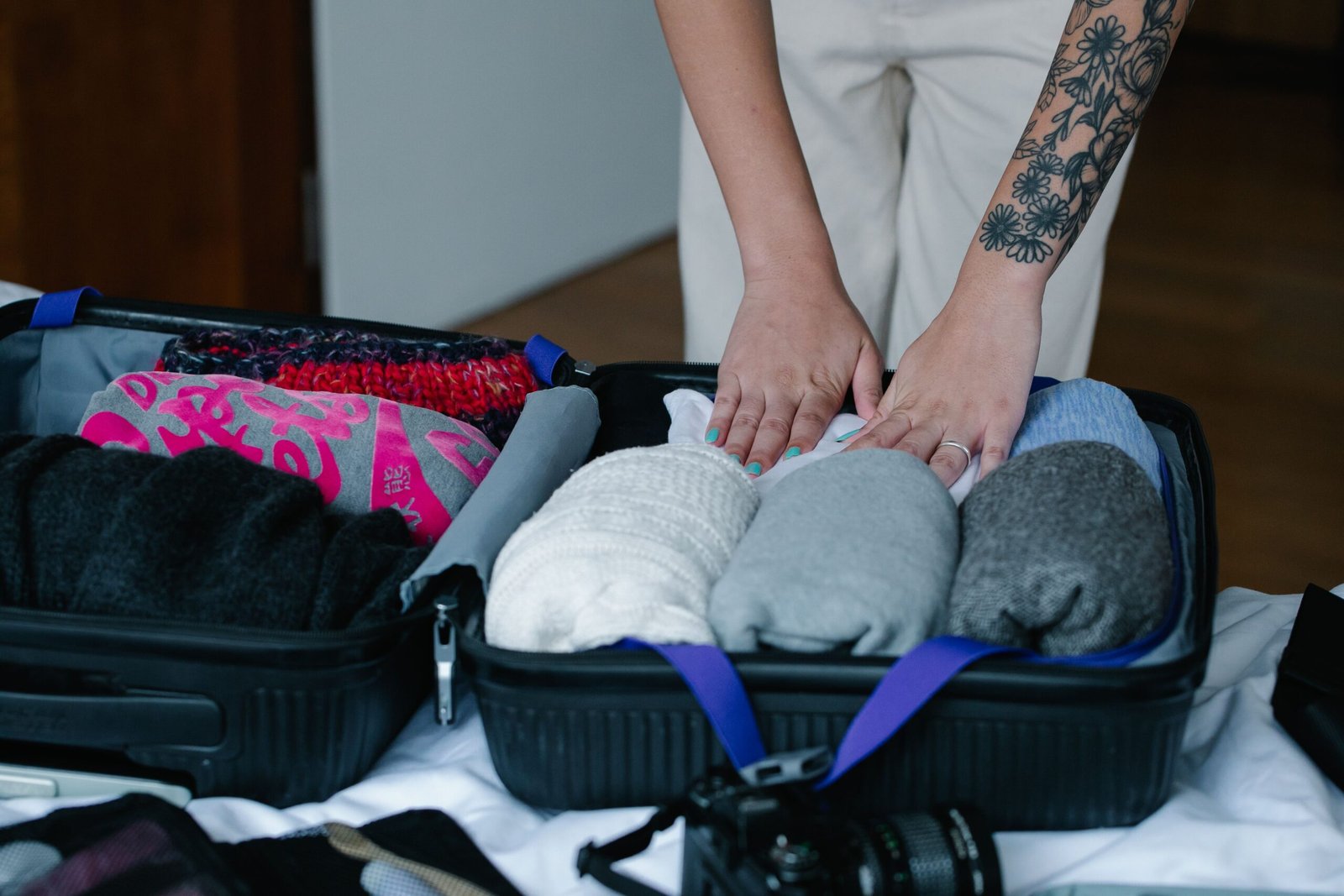
I was a fool for years. I would lay everything flat, stack it neatly, and wonder why my suitcase looked like a fabric explosion by day three. Then I learned to roll, and it changed everything. Rolling clothes tightly not only saves space but also prevents wrinkles, because the fabric is under tension rather than creased at hard angles. T-shirts become tight little burritos. Pants get folded in half lengthwise and rolled from the cuff up. Underwear and socks get rolled into tiny balls and stuffed into shoes, which keeps the shoes from collapsing and uses space that would otherwise be wasted.
For extra compression, I use packing cubes. Not the fancy, expensive ones, though those are nice. Any lightweight zippered pouch will do. I separate my clothes into categories: tops in one cube, bottoms in another, and underwear and socks in a third. This serves two purposes. First, it compresses everything so you can fit more. Second, and more importantly, it keeps you organized. You do not have to unpack your entire bag to find one shirt. You pull out the top cube, grab what you need, and zip it back up. When you are living out of a suitcase for two weeks, this kind of order is sanity-saving.
I also pack a lightweight tote bag or a packable daypack. This folds down to nothing but becomes your daily bag for walking around, your beach bag, your grocery bag, or your overflow bag for the flight home when you have inevitably bought more than you planned.
What to Wear on the Plane
This is strategy, not fashion. Wear your heaviest items on the plane so they do not take up space in your bag. For me, that means my bulkiest shoes, my jeans, and my heaviest layer, whether that is a sweater or a light jacket. I also bring a large scarf or pashmina, which doubles as a blanket on freezing airplanes and a wrap in chilly churches or restaurants.
The plane outfit should be comfortable enough to sleep in but presentable enough that you do not look like you just rolled out of a tent when you land. A soft t-shirt, stretchy jeans, a cardigan or hoodie, and those bulky shoes. I also pack a change of clothes in my personal item, the bag that goes under the seat. If I’m checked… well, if my only bag gets lost or delayed, I have one clean outfit to get me through the first day while the airline figures out where my life went.
Laundry: The Secret Weapon
The reason most people overpack is that they are packing for fourteen distinct days of clean clothes. But you do not need fourteen outfits. You need seven, or even five, and a plan to wash them.
Doing laundry on vacation sounds like a chore, but it is actually one of the great travel hacks. It takes thirty minutes, it forces you to slow down, and it makes you feel like a local. I have done laundry in laundromats in Paris, in hostel sinks in Thailand, and in hotel bathrooms in Mexico City. I bring a small ziplock bag of laundry detergent sheets, which weigh nothing and dissolve in water. In a pinch, hotel shampoo works fine for hand-washing socks and underwear in a sink. Hang them over the shower rod, aim the fan at them, and by morning, they are dry.
If your accommodation has a washing machine, even better. Many Airbnbs in Europe do. Many hostels have laundry rooms. And almost every city on earth has a laundromat or a service that will wash and fold your clothes for a few dollars. Dropping off a bag of laundry and picking it up clean and folded a few hours later is one of the small luxuries of long-term travel. It costs less than one checked bag fee, and it means you can pack half as much.
The “Just in Case” Trap
This is where most packing attempts die. The “just in case” items. The umbrella, even though the forecast says sun. The second jacket, just in case the first one gets wet. The extra pair of jeans, just in case I get tired of the first pair. The dress shoes, just in case we go somewhere nice. The first aid kit with seventeen bandages and a splint, just in case I fall off a cliff.
Here is the rule I live by: if it is not a definite yes, it is a no. If you are not 100 percent sure you will use it, do not bring it. You can buy an umbrella anywhere. You can wear your one nice outfit twice. You can wash your one pair of jeans. And if you actually fall off a cliff, a splint from your suitcase is not going to be the thing that saves you.
The only exceptions are small, high-impact items that fix common problems. A few safety pins. A small roll of duct tape wrapped around a pencil. A portable phone charger. These weigh nothing and solve everything. But that extra sweater? That third book? That travel pillow that inflates? Leave them. You will not miss them. You will be too busy having the trip.
The Souvenir Problem
Two weeks is long enough to accumulate things. A bottle of wine. A piece of pottery. A book you found in a shop that you simply must have. If you pack your carry-on to the absolute limit on the way there, you have no room for the way back. So leave a little space. Or better yet, pack a foldable duffel bag that can serve as your personal item on the return flight, filled with your treasures. I have also been known to mail things home. Post offices exist. They are charmingly old-fashioned, and they work.
The Final Check
Before I zip my bag, I lay everything out on the bed, and I ask each item three questions. One: Have I used this in the last month? Two: Can I buy this there if I need it? Three: Will I be miserable without it? If the answer to all three is no, it stays home. It is a ruthless process, and it hurts a little. But then I pick up my bag, and it is light, and I can lift it over my head into the bin without help, and I can walk down a cobblestone street without sounding like a wheelbarrow full of rocks, and I realize that the thing I thought I needed was actually just weighing me down.
Traveling with a carry-on for two weeks is not about deprivation. It is about liberation. It is about walking off a plane and straight into your day without waiting at a baggage carousel. It is about navigating subway stairs without fear. It is about knowing exactly what you own because you can see it all at once. It is about realizing that you need so much less than you think you do, not just to travel, but to live.
So pack light. Pack smart. Wear the same shirt twice. Buy the sweater in Copenhagen if you have to. And then go. The world is waiting, and it does not care what shoes you are wearing.